Loop Closure
Overview
This derivation answers the question: what does it take for an observer to persist?
Having a conserved quantity (Axiom 1) and a self-maintaining identity (Axiom 2) is not enough. An observer must actively sustain itself — its current state, processed through its own dynamics, must reproduce a valid observer state. This is self-reference: the observer is a process that instantiates itself.
The argument. Self-reference under finite resources forces loop structure:
- An observer’s internal state must be self-generating: the current configuration determines the next configuration. This is a deterministic flow on the state space.
- The observer has finite resources — a compact state space with finite coherence. A flow that drifts without returning will eventually cross the observer’s boundary and dissolve.
- Approximate return is not enough. Each imperfect cycle accumulates drift, giving the observer a finite lifetime proportional to how tightly the cycle closes (the drift bound).
- Only exact return — the state returning precisely to its starting configuration — gives indefinite persistence. Exact return of a continuous flow is periodicity, and periodicity is symmetry.
The result. Every persistent observer has a natural frequency (how fast its loop cycles), a coherence cost (the minimum resources needed to complete one cycle), and a conserved charge paired with its cyclic symmetry. The loop is not an additional constraint imposed on observers — it is what self-reference looks like for a finite system. Moreover, the composition of observers forces all frequencies to be commensurate: there exists a universal fundamental frequency such that every observer’s frequency is an integer multiple of . The discrete energy spectrum of quantum mechanics — — follows as a structural consequence.
Why this matters. Periodicity gives rise to frequency, frequency gives rise to energy (via the Planck-Einstein relation derived later), and the requirement of a minimum coherence cost per cycle is what ultimately produces Planck’s constant. The universal frequency grid means energy is inherently discrete — not because nature “chooses” to quantize, but because any other arrangement would make composite observers impossible. The wave-like behavior of quantum mechanics traces back to this requirement: to exist is to oscillate, and to coexist is to oscillate commensurately.
An honest caveat. The step from “indefinite persistence” to “exact periodicity” might appear to require ruling out quasi-periodic flows (where the orbit is dense in a higher-dimensional torus rather than closing as a circle) by appeal to physical requirements like the discrete energy spectrum. In fact, the exclusion of quasi-periodicity follows from the operational definitions themselves, via a composition argument: composite observers (Definition 5) must satisfy loop closure, which forces all sub-observer frequencies to be commensurate. See the Operational Grounding section below and From Observation to Axioms.
Statement
Axiom 3 (Loop Closure). Every observer’s internal dynamics is self-sustaining and periodic: the state returns to its initial configuration after a finite period. A self-referencing system with finite resources that does not close its loop eventually dissolves. Loop closure is what makes an observer persistent in the sense of Axiom 2.
Operational Grounding
Every formal element of this axiom follows from the five operational definitions established in From Observation to Axioms. This section traces the forcing arguments.
Dynamics, continuity, and recurrence. Self-sustaining dynamics is forced by persistence (Definition 3): the observer maintains its identity through repeated interactions, so the current state must determine the next — giving a one-parameter flow on . The homomorphism property () follows from determinism: evolving for then must equal evolving for . Continuity is forced by Definition 1 (observation as residue): operationally similar states produce similar residues, so the flow cannot jump. From Axiom 2, the state space is compact (O1); a continuous flow on a compact space that drifts without returning accumulates displacement (the drift bound, Proposition 2.3), giving a finite lifetime that contradicts persistence. So persistence forces recurrence.
Smooth dynamics from the Noether link. Continuity is forced, but smooth () dynamics requires a further argument. Definition 2 says the observer “maintains its identity through interactions” — the word through is load-bearing. The invariant is not merely accidentally unchanged by the dynamics ; the dynamics is the mechanism by which identity is maintained. The loop IS the identity-maintenance process. The formal expression of “the dynamics generates the invariant” (as opposed to “the dynamics happens not to change the invariant”) is the Noether mechanism: is the conserved charge of the action, linked via the Lie algebra generator , the generating vector field , and the moment map. This identification requires a Lie algebra (to define ), a smooth action (for to exist), and a smooth manifold (for the tangent bundle and differential forms). On a non-smooth space, all three ingredients fail: the three axioms remain individually satisfiable — a conserved measure, a continuous invariant, and a periodic homeomorphism can coexist — but the Noether mechanism that connects them is severed. The invariant becomes accidentally preserved rather than structurally generated, and “maintains identity through interactions” loses its structural content. Three independent downstream requirements independently converge on at least differentiability (the coherence cost integral requires velocity ; the Fisher metric requires regularity; the Noether theorem requires a smooth Lie group action), confirming the minimum from multiple directions. Whitney’s theorem (1936) then upgrades to the unique compatible structure.
Exact periodicity from composition. The drift bound forces recurrence but not exact closure. Quasi-periodic flows — orbits dense in a torus with incommensurate frequencies — also recur, with along an increasing sequence, giving infinite effective lifetime without exact closure. One might think the exclusion of quasi-periodicity requires an appeal to the discrete energy spectrum, but it is in fact forced by the operational definitions via composition.
Consider a system with quasi-periodic dynamics on . Its state space factors as ( factors), with each factor carrying a free action at frequency . Each factor individually satisfies Axioms 2 and 3 — it is an observer with exact period . By Definition 5, their composite is also an observer, and by Axiom 3 the composite’s dynamics must satisfy for some . But , so requires for all simultaneously — a common period. Incommensurate frequencies have no common period (by definition: for some pair makes and unable to simultaneously be integer multiples of ). Therefore the frequencies must be commensurate: there exists a fundamental frequency such that for positive integers . The composite’s period is , and .
Since any two observers can form a composite (Definition 5), and every composite must satisfy Axiom 3, all observers in the universe must have frequencies commensurate with each other — they sit on a single fundamental frequency grid. Quasi-periodicity is excluded, and the discrete energy spectrum () follows as a structural consequence rather than an external physical requirement.
Symplectic structure from composition. The Noether pair (Theorem 5.1) requires a symplectic form on the state space. For a single minimal observer (, one-dimensional), symplectic structure does not exist — is odd-dimensional. But the Noether pair is trivial for the minimal observer: the conserved charge is just the phase itself. The non-trivial Noether pairs — where the conserved charge carries real physical content — arise for composite observers, and there symplectic structure is intrinsic. By Definition 5, composite observers exist. By Axiom 3, each observer carries a action on its state space. The product state space of two interacting observers therefore carries a canonical symplectic form from the two angle coordinates — this is intrinsic to the smooth product structure and requires no additional input. Constrained composites, whose state spaces are level sets of relational invariants, inherit symplectic structure via standard symplectic reduction (Marsden-Weinstein theorem). More generally, any product of orbits has a natural symplectic form from the wedge product of angle 1-forms, so the bootstrap hierarchy of composite observers automatically carries symplectic structure at every level.
Remaining mathematical consequences. Given smooth structure, exact periodicity, and symplectic structure (all established above), the remaining formal elements follow without further input: the action is the mathematical packaging of periodicity (Corollary 4.3); free orbits follow from coherence cost positivity, since a fixed point carries zero cost (Lemma 0.0); Lyapunov stability (neutral, not asymptotic) is forced by coherence conservation via Liouville’s theorem; the invariant Riemannian metric exists by Weyl averaging over the compact action (Theorem 0.1); and the coherence cost integral is well-defined and positive given the metric and smooth structure (Proposition 7.2).
Remark. Theorem 0.2 in the “State Space Structure” section below gives the full proof that observer state spaces are compact smooth manifolds. The base case () and the construction operations (products + level sets of smooth functions) are axiom-level; the downstream pages Relational Invariants, Bootstrap Mechanism, and Aperiodic Order provide the concrete mechanism by which these operations are realized in the framework.
All thirteen formal elements of this axiom are traced to the five operational definitions.
State Space Structure
Theorem 0.2 (State space is a finite-dimensional compact smooth manifold). The state space of any observer is a finite-dimensional, compact, smooth manifold. The manifold structure follows from the constructive mechanism by which observer state spaces are built.
Proof. The proof proceeds by induction on composition depth, using the fact that the framework constructs observer state spaces from orbits rather than placing observers into a pre-existing manifold.
(i) Base case. The minimal observer has state space — a compact, connected, 1-dimensional smooth manifold. This follows from Axiom 3 ( loop closure gives a faithful action, Corollary 4.3 below) and O1 of Axiom 2 (compactness and connectedness). is a Lie group, hence automatically smooth. No postulate is needed: the manifold structure is intrinsic to the Lie group.
(ii) Inductive step (composition). Suppose observers and have state spaces and that are compact smooth manifolds (inductive hypothesis). By Definition 5 (composition), their composite is an observer. The composite’s state space is formed from the product , possibly constrained by the relational invariant — a smooth function on the product (smooth because the individual state spaces and actions are smooth):
The product is a compact smooth manifold (products of compact smooth manifolds are compact smooth manifolds). At any regular value , the level set is a smooth submanifold by the regular value theorem. It is compact (closed subset of a compact space) and connected (the action on the level set is transitive on connected components). The concrete mechanism by which interactions generate relational invariants is developed in Relational Invariants (Theorem 3.2) and Bootstrap Mechanism (Theorem 1.1); the structural conclusion — that the resulting state space is a compact smooth manifold — follows from the axiom-level construction (products + level sets of smooth functions).
(iii) Finite dimensionality. Each composition step adds at most one degree of freedom (the orbit of the new relational invariant’s symmetry). An observer participates in finitely many interactions (the observer network has finite local complexity — see Aperiodic Order, Proposition 2.0), hence has finitely many relational invariants, hence finitely many factors. .
(iv) Summary. Every observer’s state space is constructed by a finite sequence of operations — products and level sets — starting from (a Lie group manifold). Each operation preserves compactness, smoothness, and finite dimensionality. The manifold structure is a consequence of the construction, not an assumption about the state space.
Lemma 0.0 (Free orbits from Axiom 3). The action on is free: no point of is fixed under all .
Proof. Case (minimal observer): . A non-trivial continuous action on has no fixed points (a rotation with a fixed point is the identity, contradicting non-triviality from Axiom 3). So the action is free.
Case : Suppose is a fixed point: for all . The orbit through is the single point , which has zero length. The coherence cost of this orbit is zero: . But by Proposition 7.2 (below), every point in an observer’s state space must have positive coherence cost — zero-cost states carry no coherence and cannot contribute to the observer’s conserved invariant . A state that does not participate in the dynamics is not part of the observer (it violates the self-referential character of loop closure: to persist is to cycle). Therefore no fixed point exists, and the action is free.
Theorem 0.0 (Smooth structure). admits a smooth manifold structure, unique up to equivariant diffeomorphism, such that the action from Axiom 3 is smooth.
Proof. By Theorem 0.2, is a compact topological manifold of dimension with a free continuous action (Lemma 0.0).
Step 1 (Smooth structure exists). Since the action is free, is a principal -bundle over the orbit space , which is a compact topological manifold of dimension Bredon, 1972. By the equivariant smoothing theorem for compact Lie group actions on topological manifolds Illman, 1983; Orlik, 1972, there exists a smooth structure on making the action a smooth Lie group action.
Step 2 (Uniqueness). For : every compact topological manifold of dimension admits a unique smooth structure (dimension 1: elementary; dimension 2: Radó, 1925; dimension 3: Moise, 1952). The smooth action is then the unique smoothing of the continuous action. For : by the uniqueness part of the equivariant smoothing theorem Illman, 1983, any two smooth structures making the compact Lie group action smooth are equivariantly diffeomorphic, so the equivariant smooth structure is unique.
Remark. For the minimal observer (, ), Theorem 0.0 is trivial: has a unique smooth structure and every continuous action on is automatically smooth. The theorem’s content becomes substantive for higher-dimensional state spaces.
Theorem 0.1 (Invariant Riemannian metric). The state space carries a -invariant Riemannian metric with for all .
Proof. Step (a): Existence of a Riemannian metric. Since is a smooth manifold (Theorem 0.0) and is compact (O1 from Observer Definition), it admits a Riemannian metric . (Standard result: every smooth manifold admits a Riemannian metric, constructed via a partition of unity subordinate to an atlas. Compactness ensures a finite partition suffices.)
Step (b): Weyl averaging. The dynamics generates a action on (Corollary 4.3), and is compact. Define the averaged metric:
where is the normalized Haar measure on and .
- is Riemannian: For any non-zero , since is positive-definite and is a linear isomorphism. The integral of positive functions with respect to a probability measure is positive. So for all .
- is -invariant: For any in the action, by translation-invariance of Haar measure on .
Remark (Canonical choice). Theorem 0.1 establishes existence using an arbitrary initial metric. The Fisher Information Metric provides a canonical choice: the unique (up to scale) Riemannian metric on invariant under sufficient statistics (Čencov’s theorem). Since the Fisher metric is already -invariant when is constant along orbits (which holds by invariant preservation), it provides a distinguished -invariant metric without averaging.
Two Realizations of the Action
The action established by Axiom 3 admits two structurally distinct physical realizations, both compatible with the operational definitions and with the formal apparatus of Theorems 0.0–0.2.
Definition 0.3 (Phase-space realization). The action is generated by the time-translation Noether vector field on the observer’s rest-frame phase space . The conserved charge is the rest energy . The state-space loop is the Compton oscillation at period .
Definition 0.4 (Internal realization). The action is generated by an internal symmetry — a gauge phase, a charge phase, or an internal Lie-algebra subgroup acting on at fixed spacetime location. The conserved charge is non-energy (electric charge, baryon number, spin component, etc.).
Theorem 0.5 (Both realizations satisfy Axiom 3). Either realization individually satisfies Axiom 3, and an observer may carry one, the other, or both. The phase-space realization is universal — every observer with finite Compton period carries it via time-translation Noether. The internal realization is contingent — only observers with non-trivial internal symmetry carry it.
Proof. The compactness, periodicity, smoothness, free-orbit, and Noether-link requirements of Axiom 3 are each satisfied by either realization individually. For the phase-space realization, Lemma 0.0 applies: the Compton oscillation is a free orbit with positive coherence cost, period , and conserved charge (the time-translation Noether charge). For the internal realization, the same requirements are satisfied with the gauge / charge phase replacing the rest-frame oscillator phase and the internal Noether charge replacing the energy. The two realizations are structurally orthogonal (different conserved charges, different generators, different state-space directions); an observer carrying both has two independent subgroups within and the formal apparatus extends without modification.
Remark (The pre-axiom operational ground forces this reading). Axiom 3 is derived from the operational definitions (From Observation to Axioms) — in particular, from the requirement that an observer maintain its identity through more than one transformation. The pre-axiom definition does not specify which loop is the identity-maintenance loop; it requires only that some closed loop in the state space returns the observer to itself across multiple transformations. The phase-space loop (Compton oscillation at period ) is such a loop and carries the time-translation Noether charge that Axiom 3 demands. There is no operational ground for restricting Axiom 3’s to internal realizations only; doing so would be an additional postulate beyond the operational definitions, not a consequence of them. The framework therefore admits both realizations.
Two-Axis Entity Category Taxonomy
The two realizations of Axiom 3’s generate the structural axis along which the framework’s elementary observers are subdivided. Combined with the Three Interaction Types classification — which distinguishes off-ledger Type-I quanta, ledgered elementary observers, and ledgered Type II composites — they define a two-axis taxonomy of framework entities (formalized in Entity Category Taxonomy):
Axis 1 (interaction-taxonomy origin): Type-I quantum / Elementary observer / Type II composite.
Axis 2 (internal-symmetry profile): Internal-charge-carrier (carries internal via Definition 0.4) / Self-conjugate (carries only phase-space via Definition 0.3; all internal charges zero).
The Higgs is the canonical {Elementary, Self-conjugate} observer: phase-space at rest-frame Compton period s with conserved charge , and zero internal charge under every unbroken framework gauge symmetry. The electron is the canonical {Elementary, Internal-charge-carrier} observer: phase-space via time-translation plus internal via electric charge. See Entity Category Taxonomy for the exhaustiveness theorem and the full Standard Model placement.
Formalization
Step 1: Self-Sustaining Dynamics
Definition 1.1 (Internal dynamics). Let be an observer (Axiom 2). The internal dynamics of is a smooth group homomorphism:
satisfying:
- Homomorphism: and
- Smoothness: The map is smooth as a map
- Invariant preservation: for all , (follows from )
Remark (Self-reference). The requirement encodes self-reference: the observer’s dynamics preserves the very invariant that defines the observer. The state at time is produced by the observer’s own symmetry group acting on the state at time . The observer is, in this precise sense, a process that instantiates itself.
Step 2: Approximate Closure and Dissolution
Before stating the axiom’s content, we establish why self-sustaining dynamics must eventually close into a loop.
Definition 2.1 (Boundary diameter). The boundary diameter of observer is (finite by compactness, using the geodesic distance induced by the Riemannian metric from Theorem 0.1).
Definition 2.2 (-approximate closure). An observer satisfies -approximate closure with period if:
Proposition 2.3 (Drift bound). An -approximately closed observer’s state drifts by at most from the initial state after cycles:
The state remains within as long as , giving .
Proof. By induction. For : by definition. For the inductive step, define . Then:
since -approximate closure holds uniformly over (and each ). By the triangle inequality:
Once , the drift may carry the state to (the boundary of the self/non-self partition from Axiom 2). At , the state is exposed to the full transformation group , not just . Transformations in do not preserve , so the observer dissolves.
Definition 2.4 (Observer lifetime). The observer lifetime is where .
Proposition 2.5 (Exact closure gives persistence). Exact closure () gives and .
Proof. With , exactly, so for all . The drift is identically zero.
Step 3: Persistence Forces Periodicity
Theorem 3.1 (Persistence requires exact closure). If an observer persists indefinitely (), then its dynamics satisfies exact closure: there exists with .
Proof. Suppose has no exact closure: for all . Then for every , there exists with , so . By Proposition 2.3, the observer’s lifetime at period satisfies .
The observer’s effective lifetime is . For , we would need sufficiently fast along some sequence — that is, the dynamics would need to approximate the identity arbitrarily well. By compactness of , if uniformly, then any limit point of a bounded subsequence gives (exact closure). If with no bounded subsequence, the dynamics approximates the identity only at diverging times — the observer’s “renewal period” grows without bound, meaning it takes arbitrarily long to approximately reproduce its state. This is not self-sustaining persistence in the physical sense required by the axiom: a system whose self-reproduction time diverges is not maintaining itself.
Therefore, indefinite persistence requires for some finite .
Corollary 3.1 (Memory-persistence tradeoff). Theorem 3.1 has a structural consequence for any observer that absorbs relational invariants. Each Type III interaction permanently expands the state space (Relational Invariants, Proposition 6.2), so the dynamics must re-close on a larger manifold than the one on which exact closure was originally established. The original no longer holds on the expanded space; the perturbation reintroduces drift . By Theorem 3.1, exact closure can only be regained at a (possibly nearby) new fixed point of the bootstrap functor. Since the perturbations are permanent and monotonically accumulate, an observer with nonzero memory capacity must eventually fail to re-close — exact persistence and epistemic memory are structurally incompatible. The full statement is the Memory-Persistence Tradeoff (Theorem 4.1). The minimal observer escapes the corollary because its 1-dimensional state space cannot host an additional degree of freedom.
Remark (Quasi-periodic flows). Theorem 3.1 rules out non-recurrent flows but leaves open the case of quasi-periodic flows on a higher-dimensional torus . Quasi-periodicity is excluded by the composition argument in the Operational Grounding section: composite observers must satisfy Axiom 3, forcing all sub-observer frequencies to be commensurate. The positive consequence of this exclusion is stated formally as Corollary 3.2 below.
Axiom 3 (Precise statement). The homomorphism is non-trivial (), and there exists such that .
Proposition 3.2 (Minimal period). Under Axiom 3, the minimal period exists, is positive, and satisfies .
Proof. Define . By Axiom 3, .
is closed: Let with . For any , for all . By smoothness of , . Hence .
is discrete: Suppose is not discrete. Then there exists a sequence with . For any , , so the orbit returns to at arbitrarily small positive times. By smoothness, the generating vector field must vanish at every (since the orbit is at at times converging to 0). Hence for all — the dynamics is trivial. But triviality contradicts the non-triviality requirement of Axiom 3 ().
Therefore is closed and discrete in , so exists in and .
Remark (Discrete case). If is finite, the dynamics is a bijection with for some . The minimal period is the order of in .
Proposition 3.3 (Eternal observer exclusion). No observer satisfies . The eternal-observer limit is forbidden, not a degenerate boundary case.
Proof. Three independent failure modes, each sufficient on its own.
(i) Axiom-level failure of the period set. By Axiom 3 the period set is non-empty, and by Proposition 3.2 it is closed and discrete in . Hence is a finite positive number lying in . The interpretation "" reads as ”,” which directly negates Axiom 3.
(ii) Persistence-level failure. By Theorem 3.1, indefinite persistence () requires exact closure at finite period: the alternative — approximate identity convergence at diverging times — is ruled out as not self-sustaining (a system whose renewal period grows without bound is not maintaining itself). Even reading as a limit rather than as axiom violation is therefore inadmissible.
(iii) Coherence-cost failure. The coherence cost integral (Definition 7.1) diverges as unless either along the loop or . The first is forbidden by C2 (normalization; cf. Proposition 7.2: ); the second is forbidden by Lemma 0.0 (free orbits — no fixed points of the action). A divergent is incompatible with each observer occupying a finite share of the slice’s coherence budget (Coherence Conservation).
Remark (Asymmetry with the null-trajectory boundary). The two endpoints of the period spectrum — and — are structurally asymmetric. The null-trajectory limit () is a degenerate observer boundary that admits residual content: the Type-I quanta of Three Interaction Types Step 4 propagate along the null trajectory (see Addressed Gap 1 below). The eternal limit () admits no residual content: no entity, observer or otherwise, resides there. Cosmological-scale composite observers are not eternal observers in the sense excluded by Proposition 3.3 — at each bootstrap level the level- observer has finite , with the framework’s epistemic ceiling set by the large but finite horizon period (Observer Loop Viability Theorem 8.10). Per-observer finiteness of is uniform across the bootstrap hierarchy.
Corollary 3.2 (Universal frequency grid). All observer frequencies are commensurate. There exists a fundamental frequency such that every observer has for some positive integer . The discrete energy spectrum follows.
Proof. Let and be any two observers with minimal periods and . By Definition 5, their composite is an observer. The composite’s dynamics on acts as . Axiom 3 applied to the composite requires for some , which means and simultaneously. This is possible if and only if — the frequencies are commensurate. Since this holds for any pair, all observer frequencies in the universe are pairwise commensurate. Pairwise commensurability over a countable set implies a common fundamental: for some universal and positive integers .
The energy of an observer with cycles per fundamental period is , and since coherence costs are quantized in units of (Action and Planck’s Constant), . The discrete energy spectrum is a structural consequence of composition and loop closure, not an independent physical postulate.
Remark. Corollary 3.2 is a strong result: the operational definitions alone — without any appeal to quantum mechanics — force energy quantization. The argument uses only Definition 5 (composite observers exist and satisfy the axioms) and Axiom 3 (dynamics is periodic). The universal frequency is determined by the framework’s fundamental constants via the minimal observer (Minimal Observer Structure).
Step 4: The Observer Loop as Geometric Object
Definition 4.1 (Observer loop). The observer loop of based at is the image of the orbit map:
Proposition 4.2 (Loop is a smooth embedding). For each , the orbit map defined by is a smooth embedding. The observer loop is a compact, connected, one-dimensional submanifold of .
Proof. Well-defined: If , then for some , so by periodicity. Smooth: Composition of smooth maps . Immersion: The derivative has image spanned by (non-vanishing since is the minimal period; if at some , then for all , giving as a period element with fixed, contradicting minimality). Injective: If with , then with , contradicting minimality of . An injective immersion from a compact manifold is an embedding.
Corollary 4.3 ( action). The periodicity defines a faithful smooth action on :
Proof. Homomorphism: by the group property of . Faithful: If , then , so . By minimality of , for some , giving , i.e., .
Proposition 4.4 (Orbit decomposition). For any , the observer loops and are either identical or disjoint. The decomposition is the orbit decomposition under the action.
Proof. Standard orbit decomposition for group actions. If for some , then by periodicity. If , the orbits are disjoint (orbits of a group action partition the space).
Step 5: The Noether Pair
Theorem 5.1 (Loop closure ↔ Noether pair). Assume carries a symplectic structure preserved by (i.e., ). Then:
(a) The action of Corollary 4.3 has an associated moment map , which is a conserved quantity: for all .
(b) Conversely, given a conserved quantity generating a Hamiltonian flow that is periodic with period , the flow defines a action satisfying Axiom 3.
Proof. (a) The Lie algebra has generator , whose fundamental vector field is . Since , we have . By Cartan’s formula, , and (symplectic), so . When (or more generally when in de Rham cohomology), there exists with . Conservation: (antisymmetry).
(b) Given periodic Hamiltonian flow with period , define . This is a action by the argument of Corollary 4.3, and periodicity is Axiom 3.
Remark (Assumptions). Theorem 5.1 requires: (i) a symplectic structure on , (ii) the flow preserves it, and (iii) the moment map exists (automatic if ). For a single minimal observer (), the theorem is vacuous since is odd-dimensional. For composite observers, all three conditions are satisfied: the symplectic structure is the canonical form on products of orbits (see Operational Grounding above), the flow preserves it by construction, and the moment map exists because the form is exact on the product. No additional structural assumptions are needed.
Proposition 5.2 (Relationship between Axioms 2 and 3). Axiom 3 is not logically independent of Axiom 2 — it specifies the dynamical realization. Precisely:
- Axiom 2 requires the existence of an invariant , but permits to be any non-trivial subgroup of — including purely discrete groups.
- Axiom 3 strengthens Axiom 2 by requiring to contain a subgroup acting as internal dynamics.
Proof. Axiom 2 requires to be a non-trivial subgroup. This is satisfied by discrete groups (e.g., ), which have no continuous one-parameter subgroups. Axiom 3 requires a smooth homomorphism with period , whose image is isomorphic to . This is a strictly stronger requirement.
Remark (Why a separate axiom). Despite this logical dependence, stating loop closure separately is clarifying: it emphasizes that the observer must be dynamically persistent, not merely a static configuration with a conserved quantity. It distinguishes continuous cyclic dynamics from the discrete symmetries that Axiom 2 alone would permit.
Step 6: Stability — Lyapunov Formulation
Definition 6.1 (Lyapunov stability). Using the geodesic distance induced by the Riemannian metric (Theorem 0.1), the observer loop is Lyapunov stable if for every , there exists such that:
where .
Definition 6.2 (Asymptotic stability). The loop is asymptotically stable if it is Lyapunov stable and additionally for all with .
Remark (Lyapunov vs. asymptotic). Asymptotic stability requires dissipation (contraction of phase space volume), which is inconsistent with coherence conservation in an isolated system (Axiom 1 implies phase space volume preservation via Liouville’s theorem). The physical requirement is Lyapunov stability (neutral stability), consistent with Hamiltonian dynamics. Dissipative stability occurs only for open subsystems exchanging coherence with their environment.
Step 7: The Coherence Cost of a Loop
Definition 7.1 (Coherence cost / action). Using the Riemannian metric (Theorem 0.1) and the coherence measure from Axiom 1, the coherence cost of an observer loop is:
where is the velocity along the loop.
Remark (Structural dependence). This integral requires both the metric from Theorem 0.1 and the coherence measure from Axiom 1 restricted to . Their compatibility — that is smooth on — follows from the smooth structure established in the Operational Grounding section: the Noether link forces smooth dynamics, and the coherence measure inherits smoothness from the Lie group structure.
Proposition 7.2 (Positive minimum). The coherence cost satisfies for every observer. There exists a positive lower bound .
Proof. Since is a smooth embedding (Proposition 4.2), its arc length (the loop is not a point, by minimality of and the non-degeneracy argument in Proposition 3.2). The coherence measure satisfies by condition C2 (normalization: ) combined with the fact that is a non-empty observer state space carrying non-zero coherence (an observer with would have zero coherence cost and could not sustain a loop — contradicting the physical content of Axiom 3). Since is continuous and is compact, . Therefore:
The infimum over all observers satisfying Axioms 1–3 is positive because any observer has both and . The observer achieving this infimum is the minimal observer, developed in Minimal Observer Structure.
Remark (Identification with ). The framework identifies . This identification is not part of the loop closure axiom; it is derived in Action and Planck’s Constant from dimensional analysis and the minimal observer structure.
Step 8: Frequency, Energy, and Mass
Proposition 8.1 (Natural frequency). An observer loop with period has natural frequency .
Proof. The action (Corollary 4.3) parameterizes the loop by phase . The physical period corresponds to , giving .
Proposition 8.2 (Action-energy relation). If is constant along the loop and the loop is traversed at constant speed, then , where is the constant speed and the constant coherence value.
Proof. Substituting constants into Definition 7.1: .
Remark (Constancy justification). The constancy of along the loop holds when depends only on the invariant (which is conserved along the flow). Constant speed is guaranteed by -invariance of the metric (Theorem 0.1): since is an isometry, for all , so the speed is constant for a orbit.
Corollary 8.3 (Planck-Einstein relation). Defining as the energy (action per period), and using (cf. Action and Planck’s Constant):
For the minimal observer (), equality holds: . For general observers, the quantization () giving is derived in Action and Planck’s Constant.
This is the Planck-Einstein relation.
Remark. This corollary depends on from a later derivation. The loop closure axiom provides only the structural relation ; the numerical value of is fixed externally.
Consistency Model
Theorem 9.1. The loop closure axiom is consistent: there exists a concrete model satisfying all conditions.
Model: (unit circle), (standard metric), , (constant — the radius), (the circle as self/non-self boundary), (rigid rotation with period ), (constant).
Verification:
- Thm 0.2: is a compact 1-dimensional smooth manifold. The standard rotation action is free (no fixed points). ✓
- Thm 0.0: has a unique smooth structure (elementary). The action is smooth. ✓
- Thm 0.1: is -invariant (rotation is an isometry) — consistent with the Weyl-averaged metric, which for this model equals . ✓
- Def 1.1: is a smooth homomorphism , preserves . ✓
- Axiom 3: , with . ✓
- Prop 3.2: is the minimal period. ✓
- Prop 4.2: The orbit is a smooth embedding. ✓
- Cor 4.3: is faithful. ✓
- Lyapunov stability: Rotation is an isometry, so — neutrally stable. ✓
- Coherence cost: . ✓
Remark: The model uses (constant), which satisfies invariant preservation () but has . This model demonstrates the loop closure machinery (cyclic dynamics, U(1) action, stability, coherence cost); full Axiom 2 compliance (including N3: ) is demonstrated in the composite models of downstream derivations where is non-constant.
Consequences
-
Transient vs. persistent: Virtual particles (transient fluctuations) are loops that fail to close — their . Real particles are loops with or .
-
Discrete spectrum: The universal frequency grid (Corollary 3.2) forces all observer energies onto integer multiples of . This is the origin of quantum discreteness: the discrete energy spectrum is not postulated but follows from the requirement that composite observers satisfy loop closure.
-
Mass = rest frequency: An observer at rest has its loop entirely in the temporal direction, with frequency . Mass is (using results from later derivations).
The Allowed T-Spectrum
Propositions 3.2 and 3.3 together fix that every observer’s minimal period lies in a finite open interval — bounded away from on the lower side (Proposition 3.2: closed and discrete, so ) and bounded away from on the upper side (Proposition 3.3: three independent failure modes). Combining these axiom-level bounds with downstream cutoffs from related derivations gives the framework’s full picture of which periods are admissible.
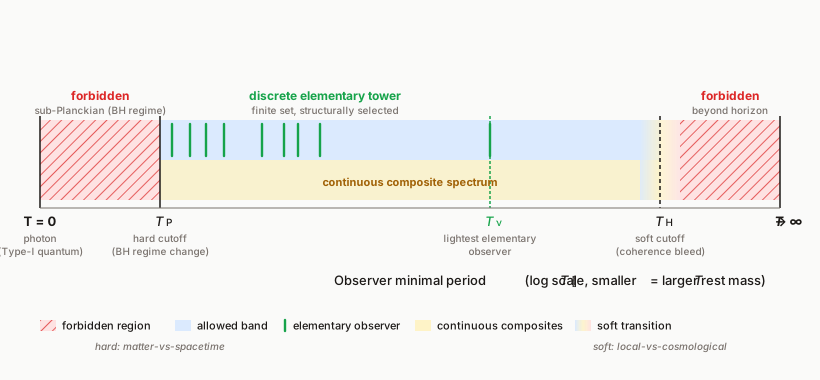
Region 1 — Null boundary (, forbidden as observer). Type-I quanta of Three Interaction Types Step 4 propagate along the null trajectory . They are off-ledger phase-transfer carriers, not observers (Addressed Gap 1).
Region 2 — Sub-Planckian forbidden region (). A would-be observer with period below the Planck period has rest energy within Compton radius . By Singularity Resolution the corresponding mass-energy density forces a horizon — the entity is in the black-hole regime, not the observer regime. The hard lower cutoff is at .
Region 3 — Discrete elementary tower (). Elementary fermion observers populate a finite set of periods in this range, fixed by the WKB tunneling spectrum of Mass Hierarchy (Yukawa eigenvalues from coherence-bounce zero-mode counting). The tower is not a continuous interval — between any two adjacent allowed elementary periods there is a structural gap. The Higgs sits inside the tower as the canonical {Elementary observer, Self-conjugate} entity (Entity Category Taxonomy).
Region 4 — Continuous composite spectrum (, extending past ). Type II composites (Three Interaction Types Definition 4.3) can occupy any period in this range — atoms, nuclei, hadrons, and larger composites populate the band continuously, with the longest periods set by slow collective modes (rotational, vibrational, oscillatory, biological, astrophysical) extending past the elementary tower’s upper edge.
Region 5 — Soft horizon ceiling (). The epistemic horizon (Observer Loop Viability Theorem 8.10) sets the upper edge of admissible periods at each bootstrap level. Loops of period exceeding cannot close within the observer’s epistemic access — coherence bleeds to the horizon sink before completion. The cutoff is soft because the bleed-off rate is continuous, not a sharp inequality. Theorem 8.10 gives a strict positive lower bound on , so is finite even in the limit.
Region 6 — Beyond-horizon forbidden region (). No observer can sustain a loop longer than the horizon period — Proposition 3.3 forbids the eternal limit, and Theorem 8.10 forbids any escape via .
Asymmetry of the cutoffs. The two boundaries are structurally distinct. The lower cutoff at is hard: a would-be sub-Planckian observer becomes a black hole, and the BH regime is its own mathematical object (not an observer with a degenerate parameter). The upper cutoff at is soft: a would-be super-horizon observer experiences continuous coherence bleed, so the cutoff is a rate-limited transition rather than a sharp boundary. The lower cutoff is matter-vs-spacetime (gravitational regime change); the upper cutoff is local-vs-cosmological (epistemic accessibility limit).
Spectrum shape. The admissible -axis is a finite-width band with a discrete elementary tower (Region 3) embedded in a continuous composite spectrum (Region 4). The discrete-in-continuous structure mirrors the framework’s two-axis entity taxonomy (Entity Category Taxonomy): elementary observers (Axis 1, middle cell) sit at structurally selected periods, while Type II composites (Axis 1, lower cell) fill the band continuously. The endpoints of the band — and — are both structural (set by Planck-scale and horizon-scale derivations), not empirical inputs.
Rigor Assessment
Fully rigorous:
- Definitions 1.1, 2.1–2.2, 4.1, 6.1–6.2, 7.1: Precise mathematical definitions
- Theorem 0.2: State space is a finite-dimensional compact smooth manifold (inductive construction from orbits via composition)
- Lemma 0.0: Free orbits (from non-triviality + coherence cost positivity)
- Theorem 0.0: Smooth structure (from Theorem 0.2 + Lemma 0.0 + equivariant smoothing theorem Illman, 1983)
- Theorem 0.1: -invariant Riemannian metric (from Theorem 0.0 + compactness + Weyl averaging)
- Proposition 2.3: Drift bound (induction + triangle inequality)
- Proposition 2.5: Exact closure gives persistence
- Theorem 3.1: Persistence requires exact closure (drift bound + compactness; quasi-periodicity excluded by composition)
- Proposition 3.2: Minimal period exists (closed/discrete subgroup argument)
- Proposition 3.3: Eternal observer exclusion (combines Proposition 3.2 axiom-level finiteness, Theorem 3.1 persistence-level finiteness, and Definition 7.1 + Proposition 7.2 + Lemma 0.0 coherence-cost finiteness)
- Corollary 3.2: Universal frequency grid (from Definition 5 + Axiom 3; all observer frequencies commensurate)
- Proposition 4.2: Loop is a smooth embedding
- Corollary 4.3: Faithful action
- Proposition 4.4: Orbit decomposition (standard group action theory)
- Theorem 5.1: Noether pair equivalence (symplectic structure from composition; see Operational Grounding)
- Proposition 5.2: Logical relationship between Axioms 2 and 3
- Proposition 7.2: Positive coherence cost (non-degeneracy + positivity)
- Theorem 9.1: Consistency model verified
Deferred to later derivations:
- (cf. Action and Planck’s Constant)
- numerical content (depends on identification)
- Mass formula (depends on speed of light derivation)
Assessment: The derivation is structured around the self-reference argument: persistence requires exact closure, which forces periodicity and symmetry. All claims are proved from the operational definitions and standard mathematical results. Quasi-periodicity is excluded by composition (commensurate frequencies). Smooth dynamics is forced by the Noether link. Symplectic structure is forced by composition. No additional assumptions remain.
Open Gaps
-
Decoherence: Environmental perturbations increase over time, eventually breaking approximate closure. A quantitative decoherence rate should follow from the perturbation spectrum acting on the coherence measure.
-
Non-abelian loops: The formalization assumes (abelian) symmetry. Non-abelian internal symmetries (, ) require replacing the single period with a representation-theoretic condition on the image of in a non-abelian group.
Addressed Gaps
-
Null-trajectory boundary — Resolved by Three Interaction Types Step 4: The limit , is the boundary at which observer status fails (Lorentz Invariance, Theorem 6.1) — no rest frame, no rest-frame loop, no realizable . Photons are not limiting-case observers but Type-I quanta — the phase-transfer currency carried between observers along the null boundary. They appear in observer accounting only as the medium of phase exchange between charged observers, never as ledger entries themselves.
-
Eternal-observer limit — Resolved by Proposition 3.3: The dual limit is forbidden by three independent failure modes — axiom-level (Proposition 3.2: is closed and discrete, so is finite), persistence-level (Theorem 3.1: requires exact closure at finite period rather than approximate convergence at diverging times), and coherence-cost-level ( diverges as unless coherence cost or velocity vanishes, both forbidden). Asymmetry with Addressed Gap 1: the null-trajectory boundary admits residual content (Type-I quanta), while the eternal limit admits no entity at all. Cosmological-scale composite observers are not eternal in this sense — they have finite at each bootstrap level with epistemic horizon from Observer Loop Viability Theorem 8.10.